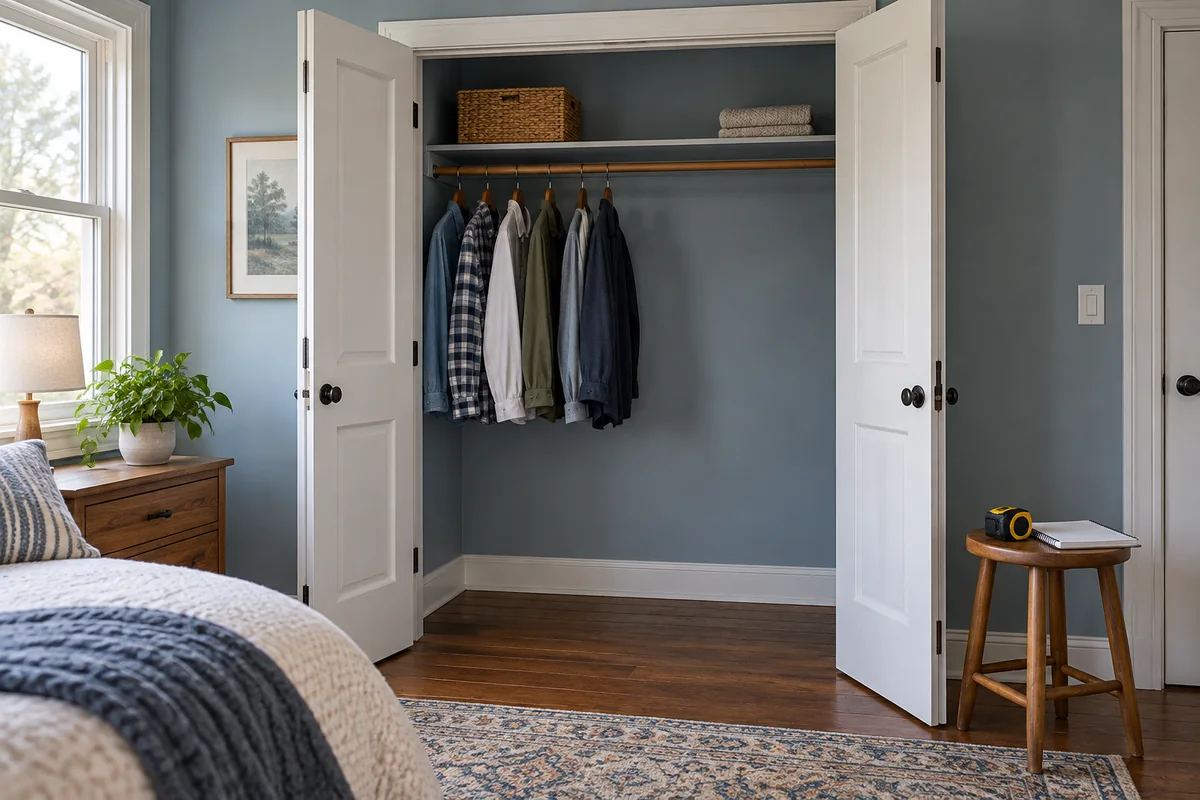
A bin can fit inside a closet and still be frustrating to use. Its lid may hit the shelf above it, a sliding door may block its handle, or hanging coats may occupy the space you thought was empty. Before shopping, record two things: the space an organizer can occupy and the space you need to use it.
This guide focuses on measuring an existing reach-in closet for bins and small organizers. A new wall-mounted system or wardrobe also needs its manufacturer’s installation and assembly requirements.
Start with the job, then the measurements
Choose one problem to solve: folded sweaters falling over, everyday shoes getting buried, or seasonal items sharing space with daily clothes. Put the actual items together before choosing containers. Otherwise, it is easy to buy matching bins that look orderly but divide the space in the wrong places.
Try writing a shopping sentence: “I need two removable bins for winter accessories on the lower shelf.” That gives you a location, a quantity, and a reason the bins must come out easily. Compare that with “I need more closet storage,” which could lead to almost any purchase.
Make a simple record of the space
Use a tape measure, a pencil, and a sketch. Write measurements in inches and label each one; an unlabeled list becomes hard to interpret later. Include a straight-on photo and a second photo with the doors fully open.
Valet Custom’s measurement guide recommends checking width at several heights and recording the smallest result. It also distinguishes closet depth, door type, the short walls beside the opening, and obstructions. Those details help explain why the opening and the interior may offer different amounts of usable space.
For your shopping notes, record:
| Location | What to write down | Why it matters |
|---|---|---|
| Proposed organizer position | Width, depth, and available height | Sets the space to compare with the product |
| Door opening | Clear opening with the door in its normal open position | Shows how the item gets in and out |
| Shelf | Usable area and space above it | A bin needs room to be grasped or opened |
| Nearby features | Trim, rod brackets, hinges, and other projections | A large empty rectangle may hide a smaller usable one |
| Normal contents | Where coats, bags, and long clothes hang | The organizer will share space with these items |
Do not move or cover electrical equipment, vents, or access panels to make an organizer fit. If a location has service-clearance requirements, confirm them before planning storage there.
Compare outside dimensions, including the handles
Use the organizer’s complete outside dimensions. Interior capacity tells you what it might hold; it does not tell you whether the exterior fits. Check whether a stated height includes the lid and whether handles or a frame project beyond the main body.
Here is a hypothetical shopping example. A shelf has 28 inches of usable width. Two bins advertised as 14 inches wide total exactly 28 inches. That leaves no side-to-side space for measurement differences, handles, or grabbing the bins. Two 12-inch bins total 24 inches, leaving 4 inches to distribute. This arithmetic makes the second option worth investigating; it does not guarantee a fit.
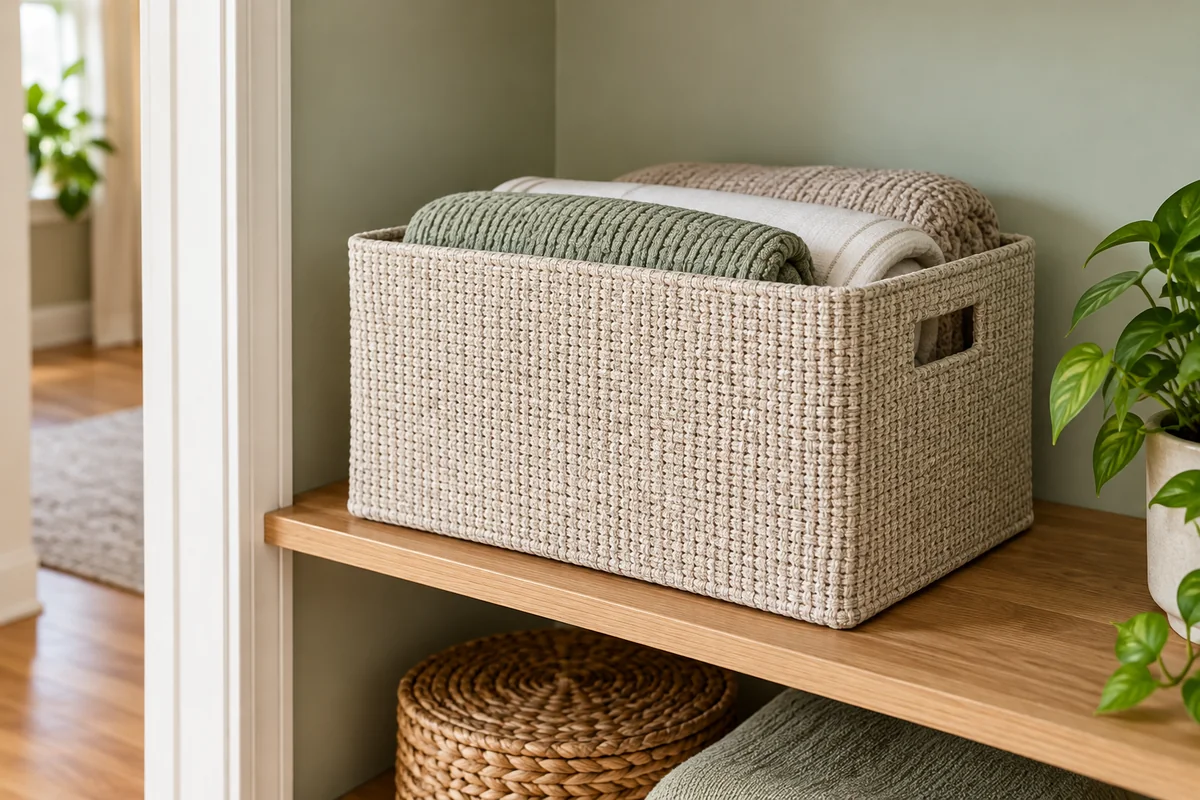
Likewise, a 10-inch-tall bin below a shelf with 11 inches of space has only 1 inch above it. Could you grasp it from the front? Would you have to slide it out before opening its lid? The useful answer depends on that specific bin and how you will use it.
Rehearse the movement before ordering a set
Use an empty box of roughly the proposed size to explore the position. Keep the closet loaded as it normally is. Open the door, reach for the box, and take it out without shifting a row of shoes first. This is a rough planning exercise, not a substitute for checking the actual product.
For a pull-out drawer, ask for its open depth as well as its closed depth. For a hanging organizer, check the rod and organizer instructions rather than assuming the existing rod can support another loaded item. If the product information leaves out a dimension you need, ask the seller before ordering multiples.
Keep installation separate from the shopping sketch
IKEA’s PAX planning page illustrates why this matters: that system has its own assembly and door clearances. Use the current instructions for your exact product, not a clearance copied from another organizer.
A freestanding cabinet may require anchoring for tip-over prevention. The CPSC’s linked anchoring guide explains that concern; putting a cabinet inside a closet does not turn it into a loose storage bin. Renters should obtain permission for required attachments and choose another solution if safe installation cannot be completed.
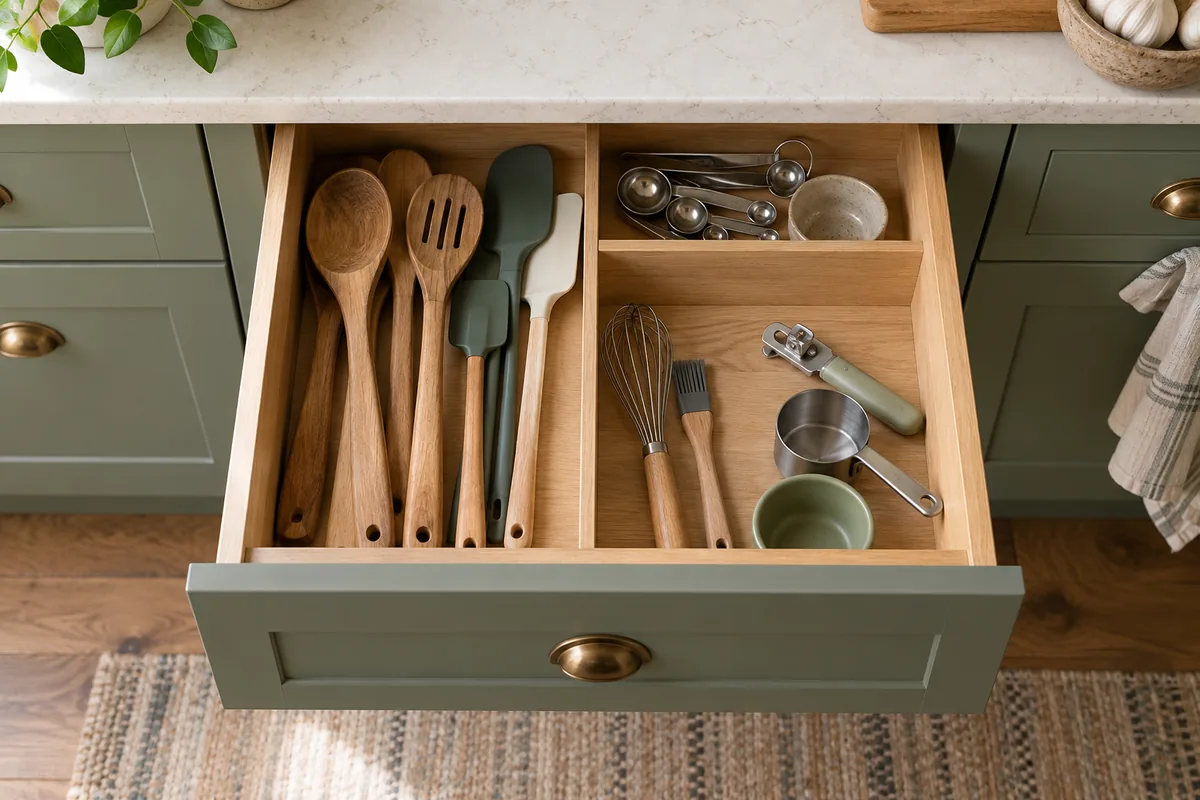
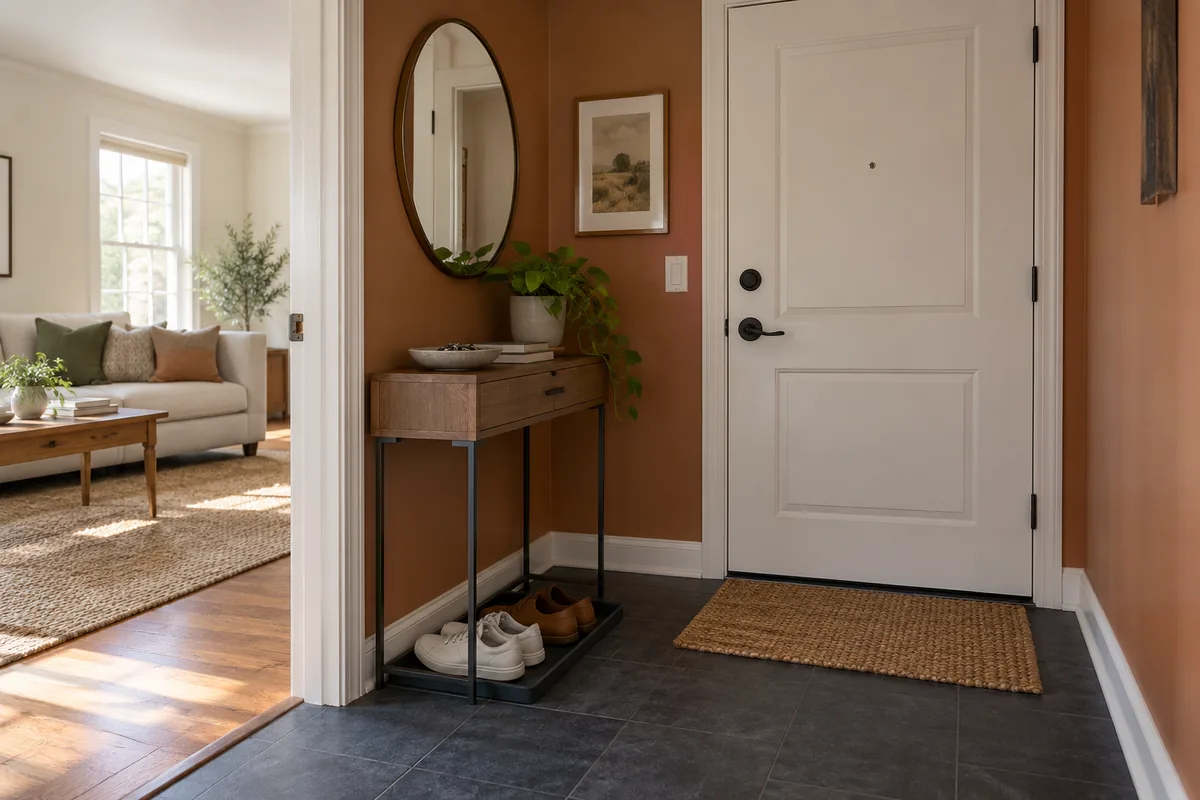
For more small-space decisions, see organizing kitchen drawers before buying inserts and planning an entryway without a closet. The same useful question applies in each place: can you reach what you need without first moving something else?
Sources and further reading
- Valet Custom Cabinets & Closets: How to Measure Your Closet Guide (PDF)
Measuring at several heights; recording depth, door type, return walls, and obstructions. The shopping examples below are our own.
- IKEA U.S.: How to design your perfect PAX wardrobe
An example of a system with specific assembly and door clearances; those dimensions are not universal closet rules.
- CPSC: Get On Top of It Before They Do! — furniture anchoring guide (PDF)
Furniture tip-over prevention when adding a freestanding storage unit, rather than loose shelf bins.
The notes above identify which guidance each source supports. Layouts and planning examples are editorial suggestions, not tested product claims.