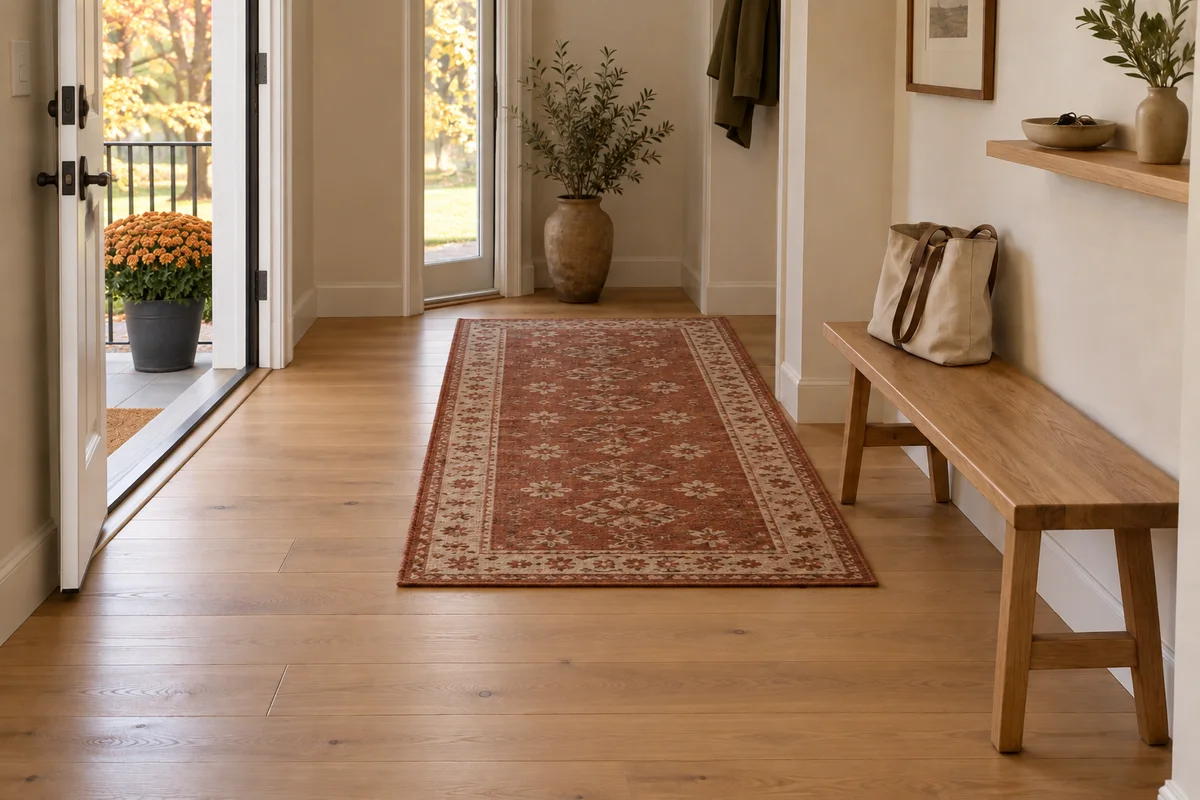
An entryway rug can look right in a room photo and still bunch up every time the front door opens. Before choosing a color or pattern, check two things: the floor area the rug will occupy and the height of everything you plan to put beneath the door.
A simple sketch and a short product comparison can help you avoid buying a rug that works only while the door is closed. Start with the doorway as it is; a decorative update should not depend on changing the door.
Decide what the rug needs to do
Is this a small mat for arriving shoes, a runner along the hall, or a decorative rug in the open area beyond the entrance? Those are different jobs. A long runner does not have to begin at the threshold, and a decorative indoor rug is not automatically suitable for wet footwear.
Note what happens when someone enters with a bag, takes off shoes, and opens a nearby closet. If the entry already feels crowded, sort out the landing zone for shoes, keys, and bags before adding another floor item.
Choose the job first, then look for products intended for that use. Check the rug’s care label and the flooring manufacturer’s instructions rather than assuming a material is suitable because it looks durable.
Sketch every door that crosses the space
Draw the entrance, nearby closet doors, the shoe tray, and any bench on a rough floor plan. Open each door through its normal range and note the area it sweeps. Include the bottom seal or sweep on an entrance door if it extends below the door itself.
Measure the proposed rug position in inches. Record where its edges would sit relative to the threshold and nearby doors. A rectangle of paper can help you visualize the footprint, but remove it before walking through or operating the door. A paper outline checks placement; it cannot reproduce the thickness or movement of a rug.
Try two arrangements on the sketch:
- A compact mat close to the entrance, if the complete rug assembly can clear the door.
- A runner or rug farther into the hall, beyond the door’s swept area.
The second arrangement may leave a bare landing area by the entrance. That can be a useful choice when door clearance is tight. Check other doors too; moving the rug away from the front door may place it under a closet door instead.
Measure the gap along the swing
With the floor clear, open the door slowly and stop at several positions over the proposed rug location. With the door stationary, measure the gap between the floor and its lowest edge, including any sweep. Keep fingers and measuring tools out of the path while moving the door. Record the smallest gap you find; a measurement at the closed position alone may miss a tighter spot.
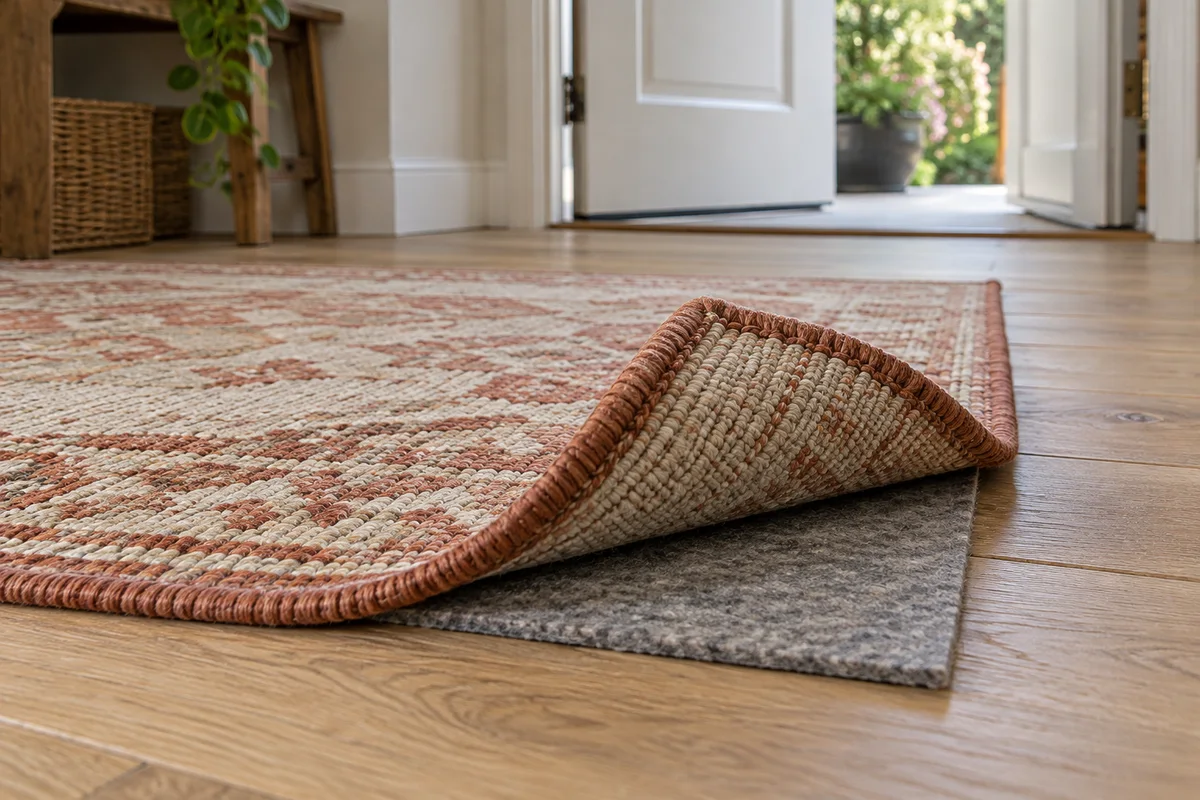
Next, get the rug’s total thickness, not only its pile height. Ask the seller whether the listed measurement includes the backing and whether the bound edge is thicker. Add the thickness of the exact pad you intend to use. If it is a combined rug-and-pad system, confirm whether the stated dimension already includes both layers so you do not count the pad twice.
RugPadUSA’s pad guide identifies pad thickness as a door-clearance consideration and discusses thinner options for entryways. That is a useful reason to check the entire assembly, rather than treating the pad as an afterthought.
A thickness example
Suppose your smallest measured gap is 1/2 inch. A hypothetical rug is 1/4 inch thick and its separate pad is 1/8 inch thick:
1/4 + 1/8 = 3/8 inch of nominal combined thickness.
Subtracting that from the measured gap leaves 1/8 inch on paper. This is a screening calculation, not a guarantee of free movement. A raised binding, a shifting edge, measurement uncertainty, or the actual product dimensions can change the result. Do not assume the door will compress the rug enough to pass.
If the numbers are close or a dimension is missing, ask for clarification before ordering. There is no single extra-clearance allowance in this guide that makes every rug and door combination work.
Compare complete options before buying
Use this worksheet for each candidate. A blank answer is a question for the seller, not a reason to guess.
| Check | Your room or product record |
|---|---|
| Intended job | Arrival mat, hall runner, or decorative rug beyond the entrance |
| Proposed footprint | Actual rug width × length, including fringe if present |
| Door interaction | Which doors cross it, and the smallest measured gap |
| Rug height | Total thickness, backing, and any thicker border |
| Underlay | Exact product, thickness, floor compatibility, and required size |
| Care | Rug and pad instructions; where each can be cleaned and dried |
| Return terms | Whether an indoor fit check is permitted and what must stay intact |
For a narrow hallway, compare the complete footprint with the space left beside furniture. Avoid choosing solely from a standard rug size or a rule about how much bare floor should show. Your doors, route, and household needs determine which layout is usable.
Check the pad and floor together
A thinner assembly still needs to stay in place. Follow the rug maker’s guidance on underlay or integrated backing, and confirm that the chosen material is compatible with your flooring and finish. Do not assume every pad works on every floor, particularly when a floor has its own restrictions or has recently been refinished.
Check sizing and care separately. For example, IKEA’s STOPP FILT product page provides underlay-specific cleaning instructions and describes sizing adjustments. Those details belong to that product; they do not establish how to wash or trim a different pad or the rug above it. Follow your exact product’s directions, and do not fold a pad into extra layers beneath a door.
If you are considering a washable rug, confirm that its actual size and care method work with your equipment and drying space. The word “washable” is only the start of that check.
Do a careful fit check when it arrives
Follow the seller’s unpacking and settling instructions, keeping return conditions in mind. With the rug and required pad flat in the intended position, operate each nearby door slowly without forcing it. Check the bound edges as well as the middle, then see whether normal walking makes the rug shift or wrinkle.
If the door rubs, catches, or moves the rug, stop using that arrangement. Try a position beyond the swing or choose a different compatible assembly. Do not trim a door, remove its sweep, or alter a shared-building entrance to accommodate a rug. In a rental, raise any door problem with the property manager.
Finally, use the entry as you normally would: arrive, put down your bag, reach for shoes, and open the closet. A good result is an entrance that remains easy to use after the styling is finished. For changes farther into the room, see our reversible living room updates.
Sources and further reading
- RugPadUSA: How to Choose the Right Rug Pad for Your Area Rugs
Manufacturer guidance on pad thickness, grip, and door clearance. Our measurement worksheet and arithmetic example are original planning aids, not product tests.
- IKEA: STOPP FILT Rug Underlay — Product Details and Care
An example of product-specific underlay materials, sizing, and separate cleaning instructions; not a recommendation for every floor.
The notes above identify which guidance each source supports. Layouts and planning examples are editorial suggestions, not tested product claims.