A small patio can become a storage puzzle when the weather changes. The chairs need somewhere to go, the cushions need their own space, and a large protective cover can make the remaining area harder to use. Plan the winter arrangement before buying another box or carrying everything inside.
The goal is a short list with a decision for each piece: it stays outside according to its instructions, moves to a suitable storage place, or needs a question answered first. Your local conditions and exact products determine that decision; there is no single winter rule for every patio set.
Start with a furniture inventory
List the table, each chair, any bench, and removable textiles separately. Find the brand and model where possible and save the current care instructions. Note the construction and finish as well as the broad material name. “Wood” or “metal” alone is not a complete storage instruction.
Manufacturer advice can differ substantially. For its NÄMMARÖ outdoor table, IKEA prefers a cool, dry indoor storage place when possible. Its outdoor-storage directions include a waterproof cover, air circulation, and removing excess water or snow from flat surfaces after precipitation. By contrast, POLYWOOD says its furniture can remain outdoors year-round and does not require covers, although covers can simplify maintenance.
Those examples show why the product instructions matter. They are not recommendations to buy either brand or permission to apply one maker’s advice to another set. If the model is unknown, ask the supplier before assuming that “outdoor” means suitable for your winter conditions.
Give every piece a destination
Use a planning table rather than a single “put patio away” task:
| Piece | Proposed destination | What must be confirmed? |
|---|---|---|
| Table | Its current patio position or a storage room | Model-specific seasonal care and complete stored size |
| Chairs | Separate floor spaces, a permitted stack, or folded storage | Whether folding or stacking is allowed; access and stability |
| Cushions and pillows | A suitable indoor shelf, bag, or other approved location | Care instructions, dry condition, and actual stack size |
| Covers and removable parts | A labeled place you can find in spring | Cover fit and care; which parts belong to which item |
Write an actual location, such as “left side of utility room,” instead of “indoors.” Then look at what already occupies that space. Winter furniture storage should not depend on moving the same pile out of the way every time you need a household item.
For cushions, use our separate small-home cushion storage guide to compare the opening, stack, and storage conditions. A cover over a table does not establish that the cushions beneath it have the storage environment their maker requires.
Measure the stored arrangement and the route
Record the furniture dimensions in the state you are allowed to store it. A chair’s folded size is relevant only if that model is designed to fold. An apparently convenient stack is relevant only if the maker permits that arrangement and it can remain stable in the chosen location.
Measure the whole footprint, including projecting feet, arms, or handles. For a permitted stack, measure the complete stack rather than multiplying the height of one chair. Keep enough access to retrieve the items without making the rest of the room unusable.
For example, suppose two hypothetical folded chairs each occupy a space 8 inches deep. Placing them side by side would suggest 16 inches before any extra room needed for their shape, protection, or handling. That arithmetic does not establish that they fit a 16-inch gap. Check the real assembled arrangement and its removal path.
If furniture must pass through doors, turns, or stairs, measure the complete moving route before starting. Arrange appropriate help for bulky or heavy pieces. Keep exits, shared access, vents, and patio drainage clear in both the moving plan and the final layout.
Prepare each item using its care instructions
Choose a dry-weather window for the work when possible. Read the product’s cleaning and drying directions before gathering supplies. A cleaner, pressure setting, coating, or treatment suitable for one finish can be inappropriate for another, so do not turn a generic storage checklist into a universal cleaning recipe.
Inspect the furniture while it is accessible. Note loose fittings, a damaged finish, or parts that need attention, then follow the maker’s maintenance directions. Store pieces and textiles in the condition those directions require, including drying after cleaning. Do not rush damp items into a closed storage arrangement to finish the job faster.
Fold or disassemble furniture only as its instructions allow. If permitted disassembly produces loose hardware, keep it in a labeled bag with the relevant assembly instructions. A photo before taking anything apart can make the spring restart easier.
Choose a cover for the configuration you will leave outside
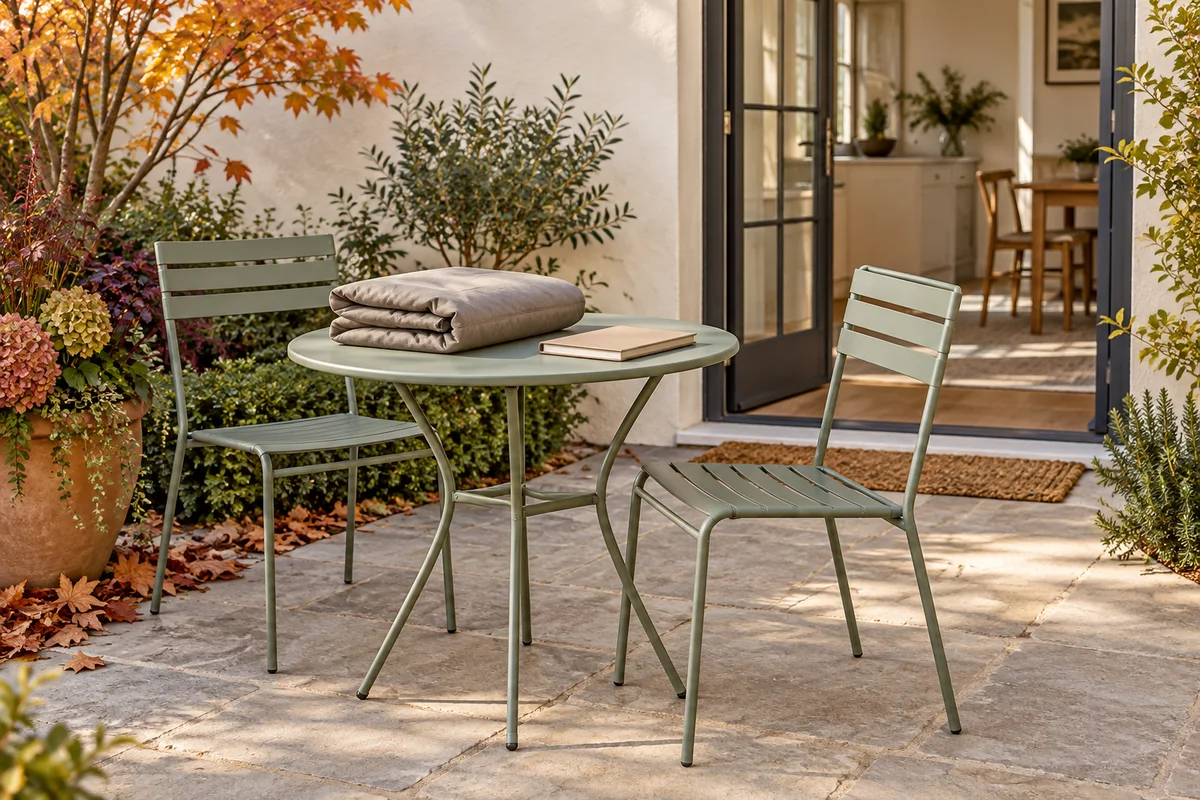
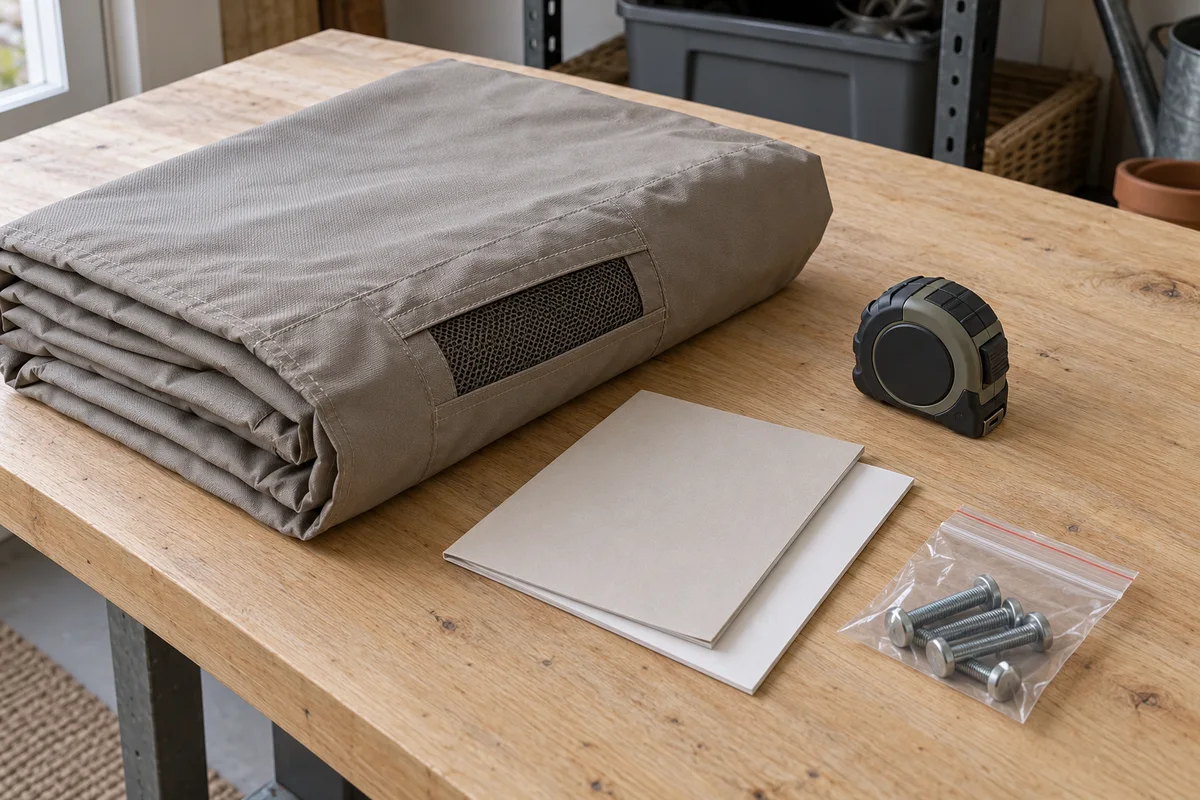
Measure the actual outdoor arrangement after deciding what moves indoors. Coverstore’s cover-selection guide discusses width, depth, and height, or diameter for round arrangements. A dining-set measurement includes the chairs, not only the tabletop.
Its guide also addresses airflow, hem clearance, and fastening. Check those details against your chosen cover’s instructions, including whether its listed dimensions describe the cover itself or the furniture it fits. Do not transfer one supplier’s sizing allowance to another product.
Avoid choosing a much larger cover simply to gather unrelated pieces underneath it. Ask the supplier how the cover should fit, shed water, and be secured. A cover is not a substitute for the furniture’s own storage requirements or an approved plan for wind exposure.
Leave a record for winter checks and spring
Photograph the finished arrangement and make one short record for each item: model, location, date stored, care completed, and any unresolved issue. Keep instructions where you can retrieve them without unpacking everything. Our home product manual folder guide shows how to connect those files to the exact model and keep unresolved questions visible.
Plan checks appropriate to the products and local weather rather than assuming the job ends when the cover goes on. Look for a shifted cover, accumulating water, damp storage, or blocked access, and respond according to the relevant instructions. For example, the IKEA table care guidance above explicitly calls for attention after rain or snow; that requirement belongs in the plan if you own that product.
In spring, review the instructions and your notes before returning pieces to use. If the winter arrangement repeatedly caused problems, use that information when planning the next season. Our small patio layout guide helps you reassess furniture footprints and access, while the Patio & Balcony Layout Planner can illustrate alternative positions. Its example furniture does not verify real storage dimensions, cover fit, or weather suitability.
Sources and further reading
- IKEA: NÄMMARÖ Outdoor Table — Materials and Care
A product-specific example of indoor storage preference, outdoor covering, air circulation, and follow-up after precipitation. Not a rule for every wood table.
- POLYWOOD: Keeping POLYWOOD Outside Year-Round
A contrasting manufacturer example: its furniture can remain outdoors year-round and covers are optional. Do not extend that guidance to unrelated products.
- Coverstore: How to Choose Patio Furniture Covers
Cover-specific measuring, fit, airflow, and fastening considerations. Follow the size convention and installation instructions for the exact cover selected.
The notes above identify which guidance each source supports. Layouts and planning examples are editorial suggestions, not tested product claims.